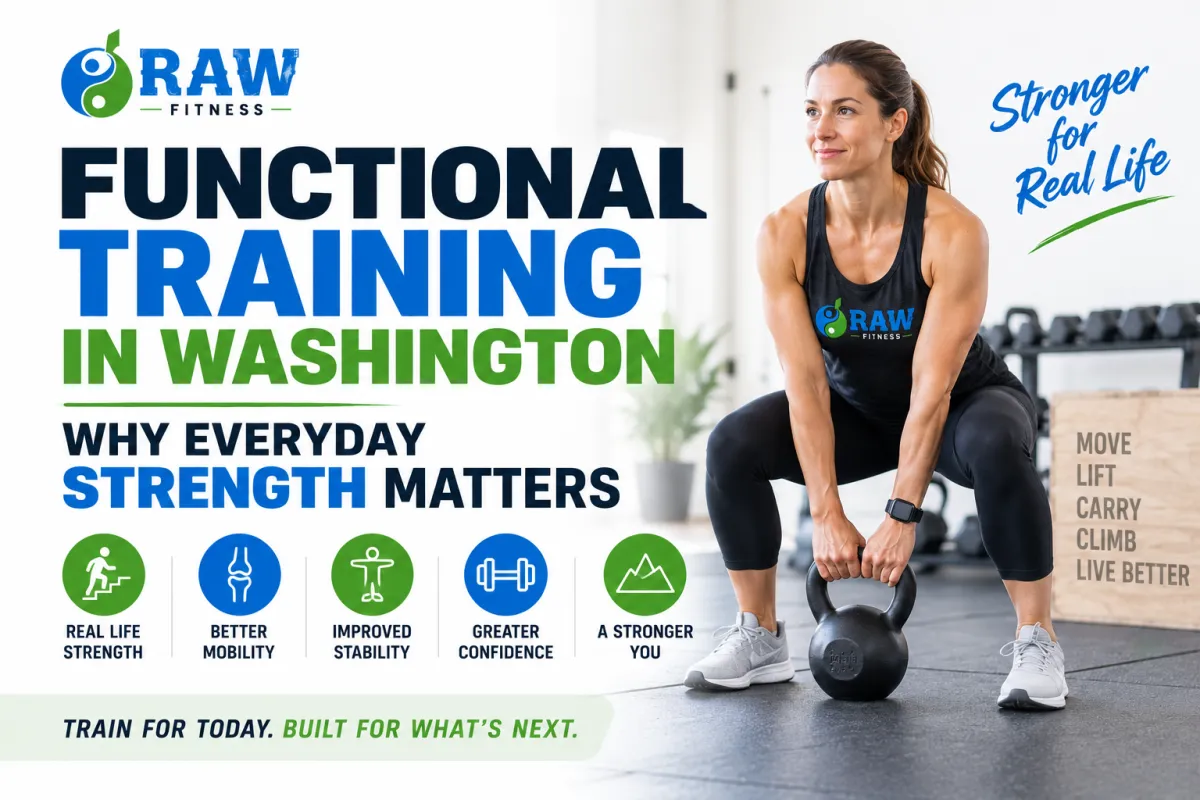
Functional Training in Washington: Why Everyday Strength Matters
What is the point of getting stronger if that strength doesn't improve your life?
It's a question worth asking.
You can spend months improving your numbers in the gym while still struggling with everyday movements.
Carrying groceries.
Getting up from the floor.
Climbing stairs.
Lifting something overhead.
Moving furniture.
Playing with your kids.
Working in the yard.
These activities don't happen on a fitness machine.
They happen in real life.
That's where functional training becomes important.
Functional training in Washington focuses on developing physical abilities that transfer beyond the gym. Instead of training only for appearance or isolated exercises, the objective is to build a body that can move, stabilize, lift, carry, push, pull, and perform everyday tasks with greater confidence.
Because being fit isn't simply about looking capable.
It's about being capable.
The Gym Is Not the Destination
A workout is a tool.
The real result should be what happens after you leave the gym.
If your training helps you move better, carry more, climb stairs with less effort, maintain better posture, and feel more confident in your body, it has accomplished something meaningful.
Functional training takes this idea seriously.
Exercises are selected because they develop useful physical qualities such as strength, coordination, balance, stability, mobility, and control.
That doesn't mean every exercise needs to imitate a household chore.
It means your training should develop abilities that your body can use outside the gym.
Everyday Strength Is Different From Gym Strength
Being able to perform an exercise once doesn't necessarily mean you're physically prepared for real-world demands.
Everyday movement is unpredictable.
You might carry a heavy bag in one hand.
You might pick something up from an awkward position.
You might need to stabilize yourself while stepping over an obstacle.
You might rotate while reaching for something.
Real life doesn't give you a perfectly positioned barbell with a clear starting position.
Functional training develops strength while also challenging your ability to control your body.
That's why movements such as carries, squats, hinges, presses, rows, and rotational exercises can be valuable components of a well-designed program.
Your Core Does More Than Create Visible Abs
The core is often associated with appearance.
But its more important role is stability.
Your core helps transfer force between your upper and lower body while providing support during movement.
A strong, well-coordinated core can help you maintain control when lifting, carrying, pushing, pulling, and changing direction.
Functional training often incorporates movements that require your trunk to stabilize while other parts of your body move.
That creates a more complete challenge than simply performing hundreds of repetitions of traditional abdominal exercises.
The goal isn't to make your workout look complicated.
It's to make your body more capable.
Balance and Stability Become More Important With Age
Strength is valuable at every age.
But as you get older, maintaining balance and physical control becomes increasingly important.
Functional training can incorporate movements that challenge stability while developing strength at the same time.
Single-leg exercises, controlled changes of direction, carries, step-ups, and other movement patterns can help train your body to control itself in different positions.
This matters because everyday life rarely happens on perfectly stable surfaces.
Your body needs to react.
Your muscles need to coordinate.
Your joints need to remain controlled.
Training these qualities can help you remain confident in how you move.
Mobility and Strength Should Work Together
Mobility and strength are sometimes treated as separate concepts.
They shouldn't be.
Having the ability to move through a position is one thing.
Having the strength and control to own that position is another.
Functional training combines these qualities.
For example, being able to reach overhead is useful.
Being able to control a weight overhead is even more useful.
Being able to squat deeply is valuable.
Being strong and stable throughout that movement is better.
The objective isn't simply greater flexibility.
It's usable mobility.
Functional Training Can Make Exercise More Relevant
Some people struggle to stay motivated because traditional workouts don't feel connected to their lives.
Functional training can change that.
When you notice that your training makes everyday activities easier, exercise becomes more meaningful.
A stronger squat helps you get up from a chair.
A stronger hinge helps you lift objects from the ground.
A stronger carry helps you handle groceries.
Better upper-body strength makes pushing and pulling easier.
Improved balance gives you greater confidence when moving around.
The connection between training and everyday life becomes obvious.
Why Structure Still Matters
Functional training doesn't mean randomly throwing together exercises that look athletic.
Good programming still requires structure.
Your training should consider your current ability, goals, experience, recovery, and progression.
You need enough stimulus to improve without constantly pushing your body beyond its ability to recover.
That's where a thoughtful functional fitness program in Washington can make a difference.
Instead of chasing complicated exercises because they look impressive on social media, the focus remains on movements that provide a meaningful training effect.
Simple doesn't mean ineffective.
Often, the basics are the most useful.
Functional Fitness Is Not Just for Athletes
You don't need to play a sport to benefit from functional training.
You don't need to be exceptionally fit.
And you certainly don't need to perform advanced movements.
Functional fitness is relevant because everyone uses their body in everyday life.
A parent lifting a child.
A professional carrying equipment.
A homeowner working around the house.
A retiree wanting to remain independent.
An active adult who wants to keep playing recreational sports.
Different people have different goals, but everyone benefits from having a body that is strong, mobile, and capable.
Building a Body That Keeps Up With Your Life
The best fitness program isn't necessarily the one that leaves you exhausted.
It's the one that helps you become better at living.
That's the real value of functional training.
You aren't simply training muscles.
You're training movement.
You're developing strength that can be used.
You're improving coordination.
You're building confidence.
And you're preparing your body for the demands that life inevitably brings.
For people looking for functional training in Washington, the goal should be more than completing workouts.
It should be creating physical capacity that carries into everyday life.
Final Thoughts
Fitness becomes much more valuable when it has a purpose beyond the gym.
Functional training provides that connection.
It helps develop the strength, stability, mobility, coordination, and control required to move through everyday life with greater confidence.
At Raw Fitness, we believe training should serve a purpose. The goal isn't simply to complete another workout. It's to help you build a stronger and more capable body that supports the life you want to live.
Whether you're working on basic strength, improving mobility, or simply trying to stay active for the long term, functional training can give your workouts a purpose that extends well beyond the gym.
Train for the gym, and you get better at exercising.
Train for life, and you get better at living.
