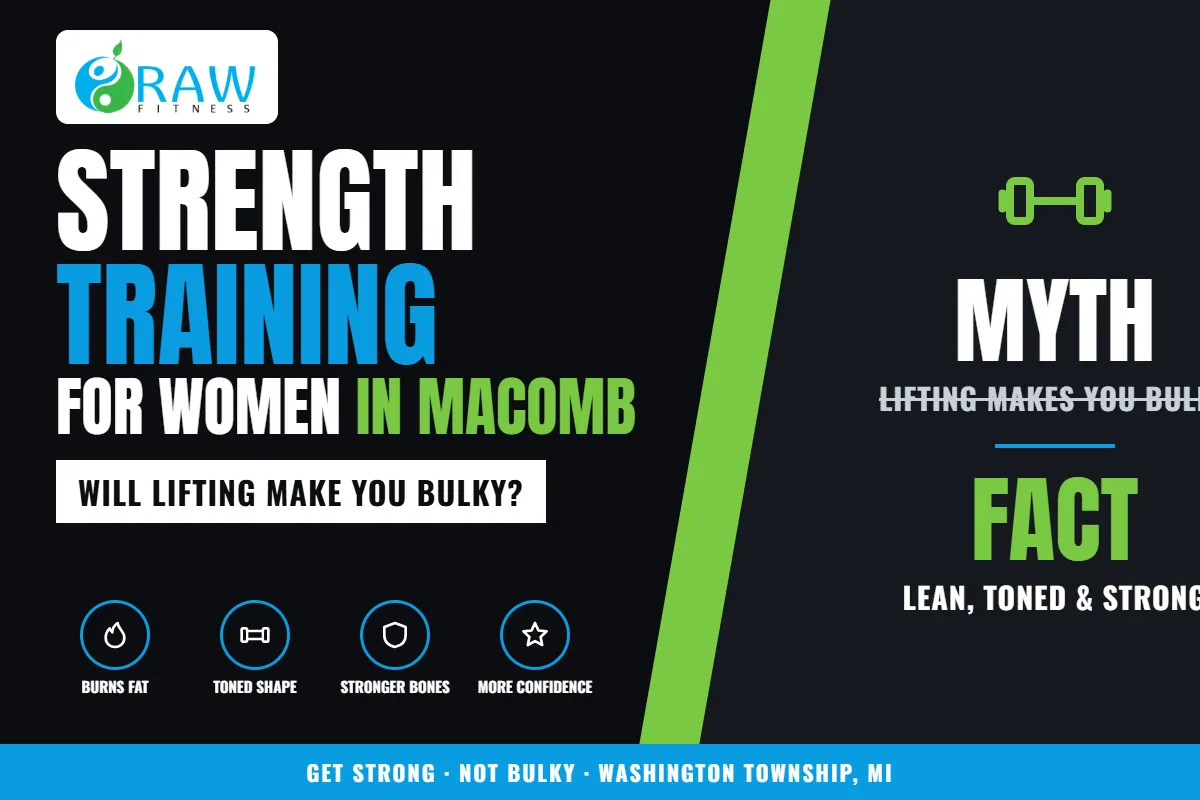
Strength Training for Women in Macomb: Will Lifting Weights Make You Bulky?
"I want to get toned, not bulky." It's one of the most common things we hear from women who walk into our studio. Many have spent years on the treadmill or in cardio classes, avoiding the weights because they're afraid of looking too muscular.
Here's the truth: strength training for women is one of the most effective ways to lose fat, look toned and feel confident. And for the vast majority of women, lifting weights will not make you bulky.
In this guide, our coaches at Raw Fitness in Washington Township break down the science, bust the biggest myths, and show you how women across Macomb County can start lifting safely.
Will Lifting Weights Make You Bulky? The Short Answer: No
Building large, bulky muscles is hard work, even for men. It takes years of very heavy training, a large calorie surplus, and often a specific genetic makeup.
Women naturally have much lower levels of testosterone, the main hormone that drives big muscle growth. That means the muscle women build through regular strength training shows up as a firmer, more defined shape, not bulk.
So what does "toned" actually mean?
"Toned" is simply having some muscle and a lower level of body fat. You can't tone a muscle you don't have. Strength training builds that muscle, and good nutrition helps reveal it.
Why some women feel "bulkier" at first
In the first few weeks, muscles can hold a little extra water as they recover, and fat loss may lag behind. This is temporary. Stick with it for 8 to 12 weeks alongside healthy eating, and most women notice their clothes fitting better and their shape becoming leaner.
6 Real Benefits of Strength Training for Women
Burns more fat over time. Muscle helps support your metabolism, so your body uses more energy throughout the day, even at rest.
Creates a leaner, more shapely look. Building muscle in your glutes, shoulders and back adds definition that cardio alone can't.
Protects your bones. Women face a higher risk of osteoporosis, especially after menopause. Lifting weights puts healthy stress on bones and helps keep them strong.
Supports healthy aging. Muscle naturally declines from your 30s onward. Strength training slows that loss and keeps everyday tasks, like carrying groceries or lifting grandkids, easier.
Improves mood and confidence. Getting stronger is empowering. Many of our members say feeling capable in the gym spills into every part of their lives.
Reduces aches and injury risk. Stronger muscles support your joints and posture, which can ease back and knee pain.
The CDC recommends that all adults do muscle-strengthening activities at least 2 days a week, working the legs, hips, back, abdomen, chest, shoulders and arms.
Strength Training Myths vs. Facts
Myth | Fact |
|---|---|
Lifting makes women bulky | Women build lean, defined muscle, not bulk, because of lower testosterone levels |
Cardio is better for weight loss | Cardio burns calories during the workout; strength training builds muscle that supports your metabolism long term. The best results come from both |
Light weights and high reps are best for toning | Challenging weights you can lift for 8 to 12 good reps build muscle more effectively |
You're too old to start lifting | Women in their 50s, 60s and beyond build strength with a well-planned program |
Weights are bad for your joints | Proper technique and gradual progress make joints more stable and less painful |
You need to spend hours in the gym | Two or three focused 45-minute sessions a week are enough to see real change |
How to Start Strength Training as a Woman
Start with the basic movements
Focus on these five foundational patterns. They work your whole body and carry over to everyday life:
Squat: goblet squats, box squats
Hinge: Romanian deadlifts, glute bridges, hip thrusts
Push: push-ups (incline to start), dumbbell presses
Pull: rows, lat pulldowns, band pull-aparts
Carry: farmer's carries with dumbbells or kettlebells
A simple beginner week
Monday: Full-body strength (squat, push, pull, core)
Wednesday: Full-body strength (hinge, push, pull, carry)
Friday: Full-body strength or a group session
Other days: Walking, mobility or rest
Progress gradually
Pick a weight that feels challenging by the last two or three reps while your form stays solid. When it starts feeling easy, increase the weight a little. That steady progress is what changes your body.
Get coaching on your form
Good technique keeps you safe and gets results faster. Working with a coach, even for your first few weeks, removes the guesswork and the intimidation.
Strength Training for Women in Macomb at Raw Fitness
At Raw Fitness in Washington Township, many of our members are women who had never lifted a weight before joining. Our coaches create a plan around your goals, your experience and any past injuries, so you always know exactly what to do.
Choose the option that fits you best:
Personal Training: One-on-one coaching with full attention on your form and progress.
Personalized Group Fitness: Your own custom plan, coached in a small, supportive group.
Nutrition Coaching: Habit-based guidance to help reveal the muscle you build.
See how real women have transformed in our Success Stories.
Ready to get strong without getting bulky? Book your free No-Sweat Intro Session. You'll get a body composition scan, a simple workout and food plan, and time to ask questions. No pressure, no judgment.
Frequently Asked Questions
How often should women lift weights?
Two to three full-body strength sessions per week is ideal for most women, with rest or light activity in between.
Will I lose weight with strength training?
Yes, especially when paired with good nutrition. You may lose fat while gaining some muscle, so track measurements and how your clothes fit, not just the scale.
Is it safe to start strength training after 40 or 50?
Yes. Strength training is one of the best things women can do as they age, helping protect bones, muscle and balance. Start with lighter weights and get guidance on form.
Should I do cardio or weights to lose weight?
Both help. Strength training builds the muscle that shapes your body, and cardio supports heart health and extra calorie burn. Learn more in our post on cardio vs. strength training.
Do I need a gym membership to start?
You can begin at home with bodyweight moves and dumbbells. A coached program speeds up progress and helps you avoid injury as you get stronger.
